Stealth Amateur Radio
In the episode of the famous TV comedy series "Hancock's Half Hour" called "The Radio Ham", Tony Hancock says: "It's a wonderful hobby. I have friends all over the world. None in this country, but all over the world!"
 If you live in a modern urban or suburban development, it can be difficult to be a radio amateur and stay on good terms with your neighbours. Times have changed since the days when power and telephone cables were routed overhead on poles, every house had a large H or X antenna for TV reception, and a ham antenna would go largely unnoticed - or at least, not make the skyline look any worse than it did already. Nowadays, phone and power lines are buried, most houses have nothing more in the way of antennas than a UHF TV antenna and a small satellite dish, and an elevated dipole, full-sized vertical or tower and beam would stick out like a sore thumb. Your housing development may have restrictions on the types of antenna you are allowed to have, or you may simply wish to avoid being the person who spoils the look of the neighbourhood by putting up something that most non-hams will find visually offensive.
The more people value the look of a neighbourhood and spend time and money making their home and garden look nice, the more they are likely to object to anything that spoils the view. So whenever I see this subject discussed in online forums and someone (inevitably) replies: "Tell the neighbours to go to hell, it's your property and you have the right to put up an antenna" I always think of that line from Tony Hancock. Is your hobby more important than being liked by your neighbours? Not to me, it isn't.
Good neighbourliness is not the only reason for wanting to avoid conspicuous antennas. If you live in an apartment or a small town house with no garden, outside antennas may simply not be possible. But all is not lost. The solution is to restrict yourself to antennas that are small, invisible or hard to see. This is stealth ham radio.
Realistic expectations
Contrary to popular belief, an inability or desire not to have large, high antennas does not mean that you should take up a different hobby. Sure, a beam or tower are out of the question, so you'll never be a "big gun" top DXer or contest winning station able to get instant replies to your CQs. But there are many other ways of being able to enjoy the hobby than chasing the rarest DX or participating competitively in contests.
It's possible to win DX awards, even using low power and modest antennas. It just takes longer. If you like taking part in contests then you can compete against yourself, trying to beat previous scores, or use them as an opportunity to log some DX that would be hard to work at other times.
Besides a less than ideal antenna, it may also be necessary to restrict the power you run so as to avoid the RFI problems that can occur with indoor antennas, or to avoid blowing your cover by causing RFI to a neighbour. This may seem like a double blow to your chances of success. But operating low power (QRP) can actually increase your fun.
The key to not being disappointed with what you can achieve with low power and a restricted antenna system is to develop realistic expectations. Compare your results to other similarly equipped stations, not big guns. Join QRP clubs and take part in QRP contests. The number of participants is smaller and the playing field is more level, making the chances of winning actually greater than if you were one of hundreds of "average" participants running 100W into dipoles or other modest outdoor antennas.
Part of the fun of amateur radio is in improving your station to get better results. Improving your station performance within the parameters of complete stealth, low visibility or whatever limits on your activity your particular situation dictates becomes part of the challenge.
Stealth antenna options
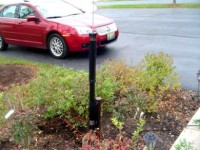 If you want to get on the air without highly visible antennas then the best solution will depend very much on your personal situation and what you can get away with. One of the first decisions you need to make is whether to go for stealth or covert operation. I don't know if there is an official definition of these terms, but for my purposes, stealth operation means "under the radar". It implies the use of outside antennas that are hard to see, whereas covert operation requires that your activities are completely undetectable. Covert operation may be required in a neighbourhood that has covenants or CCVs specifically banning antennas, but many hams in that situation opt for the stealth approach, and get away with it because nobody notices.
While researching compact antenna options I discovered the following rule of thumb:
- An antenna may have two of the attributes small, efficient or broadband (work over a wide frequency range without retuning) but never all three.
This is something you should always bear in mind when considering your options for low profile or hidden antennas. If it's small, it is either going to be inefficient or have a narrow bandwidth.
Stealth antennas that work very well are:
- Flagpole vertical. In the USA, I am given to understand, it is the right of every citizen to erect a flagpole on their property, so that they can show they are patriotic Americans by flying the Stars and Stripes. A flagpole can easily be used as, or conceal, a full sized vertical to make an efficient disguised antenna. You can even buy ready made flagpole antennas. In the UK, however, we have no such right, and blatant displays of patriotism tend to be regarded with suspicion, so for most of us it is not an option.
- Invisible wire or dipole. Another good option is a long wire or inverted L made of thin wire which is hard to see from a distance. If the feeder can be disguised then a centre-fed dipole or doublet is also possible. This option does rather depend on the availability of suitably high supports to hang the wire from. Personally I don't like this idea because I'm also a birdwatcher and fond of wildlife and I don't want to risk injury to birds who fly in to the invisible wire. Also, in the high density housing developments here in the UK where antenna restrictions are likely to apply, the plots are not big enough to accommmodate an effective long wire, and not far enough apart for such a wire to be really invisible to neighbours. But it is a good option if you can use it.
- Magnetic loops. My top choice for use where disguised or hidden full-sized antennas cannot be erected, a magnetic loop can give full-sized antenna performance for a fraction of the size. Because a magnetic loop does not look like how most people expect an antenna to look, and doesn't need to be mounted up high, you may be able to install one without anyone realizing what it is. Try mounting it on top of a pole from which you hang bird feeders, or on top of one of those metal obelisks you grow climbing plants up.
- Short vertical dipoles such as the TransWorld Adventurer. I haven't tried one, but I have heard nothing but great reports on them. They stand about 8.5ft (less than 3m) high, and actually work better (with lower angle radiation) close to the ground than elevated on a mast. Coated matt black, they are pretty hard to see.
- Loaded whip (a.k.a. "screwdriver") antennas. Loaded whips are mobile antennas. Even the most efficient loaded whip won't perform as well as a full sized vertical, but by choosing one with a very high Q loading coil such as a High Sierra, you'll still radiate a reasonable signal, at a cost of needing to retune whenever you QSY any distance. Due to its small size, you may be able to plant your whip in the garden without drawing attention to it. Use a base extension to increase performance, and as many ground radials as possible. Another possibility is to install the antenna on your car or truck and use a trailing cable to connect it to your shack. (If you try this, use a push fit connector such as an RCA phono jack and socket that will part easily if you forget to disconnect the antenna before driving away!)
Multiband antennas
Creating stealth wire or vertical antennas for a single band is relatively easy. Creating stealthy antennas that work on multiple bands is more difficult. Wire is fairly easy to conceal. Traps and loading coils are not. Non-resonant antennas tuned using an ATU in the shack ideally need to be fed using open wire, which again is hard to conceal.
A flagpole vertical could be made of fibreglass pole (yacht mast?) and a conventional trapped vertical fitted inside.
Long wires can be effective radiators, but they require a good RF ground, which can be problematic to create in a restricted situation. Without a good ground, long wires are more prone to RF in the shack, which can cause RFI. That can be particularly undesirable if you are trying to keep your operation covert. Because it may not be possible to get the wire up really high, most radiation will be at higher angles, so local contacts will be easier than DX.
A dipole requires no RF ground and no tuner, but will be good for only a single frequency. A more versatile choice is a doublet, which is essentially a non-resonant dipole. Because the feedpoint impedance is far from being 50 ohms on most bands, a doublet should be fed with open wire feeder when tuned using an ATU in the shack, to avoid feeder losses. This may present an obstacle to achieving low visibility. One way round this may be to use a battery powered remote auto-tuner at the feedpoint in the centre of the antenna, which would allow the doublet to be fed with thin coaxial cable and minimize feeder losses over a wide range of frequencies.
Small antennas
If it becomes necessary to reduce the size of the antenna in order to achieve stealth operation then some performance compromise is almost inevitable. The secret of success is to compromise as little as possible. This is where you need to be careful, as there are many antennas on the market, often with hefty price tags, that claim to defy the laws of physics by offering high performance and broadband operation in something a couple of metres long or high. Well, it just ain't possible!
Antennas that I just do not believe to be worth considering include the Crossed Field Antenna (CFA), the EH Antenna and the Isotron. They cost a lot of money, but I would have been willing to purchase any one of them if I was convinced that they lived up to the claims made about them. However, after spending much time searching for reviews and other reports of how well these antennas perform I came to the conclusion that these antennas work on the principle that anything will radiate some kind of signal as long as you can match it to a transmitter, and that customers who have low expectations are easily satisfied. I have never worked anyone using any of these antennas. If the manufacturers of these products feel I am wrong, they are welcome to lend me an example to evaluate. I am just not convinced enough to risk my own money finding out.
Ones to avoid
Other small HF antennas often suggested for attic installation or temporary outdoor deployment which I consider to be a waste of time and money include:
- Hamstick dipoles. These are dipoles made from two helically wound mobile whips mounted back to back. The problem with these is that they are simply too inefficient. Helical whips have been tested to be more than 10dB down on a full sized dipole.
- Tripod mounted helical verticals. Another type of antenna often marketed as the solution for antenna restricted locations is a helical whip such as an Outbacker, mounted on a tripod stand. Outbackers are electrically a lot like Hamsticks, except that they have taps and a flylead to short out turns and enable one antenna to cover multiple bands, so the same issue of inherent inefficiency applies. The High Sierra, with its high Q loading coil and a base extension, would be a far better bet. The problem of inefficiency is compounded if the whip relies solely on coupling between the tripod and the earth for a ground. Even full sized verticals need lots of ground radials to achieve best efficiency, and short mobile whips are no exception.
- Tripod mounted loaded dipoles such as the Buddipole. Although more efficient than a tripod mounted vertical, short loaded dipoles suffer from the fact that they have a very narrow bandwidth, and so need constant retuning whenever you QSY. This has to be done manually, by adjusting taps on a coil, making them tiresome to use. Short loaded trapped dipoles with fixed frequency coils, as offered by some Japanese manufacturers, will be very inefficient. And at the low height attained by tripod mounting, DX performance will be poor.
- Slinky dipoles made using those steel spring Slinky toys. A dipole made from one Slinky each side stretched to about 15 feet end to end will have a broad resonance on 40m; a pair of Slinkies soldered together to make each dipole leg, stretched to about 30 feet will resonate on 80m. They will radiate a signal on those bands but it is clear that they are still very inefficient, and it is a struggle to make contacts on 80m at night with 100W. Contrary to the claims made by those who advertise these antennas commercially they are not multi-band. Performance on bands other than the one the dipole is resonant on is very poor.
There are various compact HF base antennas from Japanese manufacturers such as Maldol, Comet and Diamond that may seem suitable for stealth operation. Their slimline appearance and fixed tuning on each band deny the use of any high Q components and I simply don't believe that these manufacturers have managed to discover a new law of physics that allows an HF antenna to be small, efficient and broadband!
Narrow bandwidth is good!
Many people find it inconvenient to have to retune an antenna every time they move a few kHz in frequency but, remembering the rule of thumb mentioned earlier, narrow bandwidth is normally proof of a high Q which suggests that the antenna should work better than you would expect for its size. So if you are forced to use an electrically small antenna look at the SWR bandwidth figures. Contrary to what you might think when choosing an antenna, in this case, the narrower the bandwidth the better.
That means that you really want the antenna to be tunable unless you wish to confine your operation to a narrow section of each band. This is one more reason to consider the magnetic loop. Using an ATU may compensate for a small antenna's narrow bandwidth to some extent, but though it will keep your finals happy a high Q antenna will not radiate as good a signal when it is a long way from its resonant frequency.
Indoor and attic antennas
If you need to keep your operation covert, then you probably need your antennas to be indoors, either in the attic or, in the last resort, in the shack itself. Whether or not this is possible in practise depends a lot on the form of construction used for your house, or its roof. If you have metal walls or a metal roof, or your roof lining is foil backed, then you are out of luck.
If you can't have an indoor antenna, then there are still a few options left. Some operators have laid dipoles in the plastic guttering - or better, pinched the wire between the guttering and the fixing brackets, so it doesn't lay in the water and impede the run-off of mud and leaves from the roof. I've even heard of people who have metal guttering using that as the antenna, though you'd need to ensure good electrical contact between the sections. Another possibility is to tape a wire to the back of a plastic downpipe and use that as a vertical, fed at the top or bottom against a counterpoise, or in the middle as a dipole.
If you have an attic you can use, then it can be turned into an effective antenna farm, ideal for experimentation. There is no need to bother about making your antennas water- or weather-proof and you don't have to work at heights - a major plus as far as I am concerned. If your garden or yard is as small as ours is, you'll be sacrificing little in terms of the size of the antenna you can put up, and it will be hard to gain any extra height while maintaining full stealth. The most significant downside is the proximity to wiring radiating the noise of all the switched mode power supplies used to power your electronic devices.
Antennas that work well in the attic include:
- Dipoles. Dipoles are cheap and easy to make, easy to put up and easy to match, since on the frequency they are designed for they present a close to 50 ohm load. The main disadvantage is that you need a dipole for each band, and that dipoles for the lower bands are too long to fit in the average British attic. (Even a 20m dipole would need to be bent in to a U shape to fit into mine.) The solution for multiband access is to make a fan dipole, as described (with pictures) by M0WYM (who clearly has an attic much bigger than ours.) I would endorse Peter's use of a balun at the feedpoint, to eliminate radiation from the feeder - a potential cause of RFI.
- Doublets. A doublet is a dipole that is operated over a much wider range of frequencies than those for which it provides a good match. For this to work, you must either use a remote ATU at the feedpoint, or use open wire feeder and a special ATU designed to tune open wire such as the MFJ-993B.
- Horizontal loop. This is similar to a doublet, except the antenna is a continuous loop of wire instead of two separate elements. This is often a better solution than a dipole/doublet, as you can get more wire in the air (or in the attic) and a loop tends to pick up less noise. Since you will be tuning it over a wide range of frequencies matching arrangements will be the same as for the doublet.
- Magnetic loop. As already mentioned, a remotely tuned magnetic loop is my top recommendation for an antenna in situations where a full sized antenna mounted at optimum height cannot be used. It is small enough to fit any attic, radiates a better signal than anything that even approaches its size, and can be tuned for a perfect match on any frequency within its design range. It is also inherently less sensitive to electrical noise than a dipole - a useful attribute for an antenna that is used indoors. This is my current main antenna, and is likely to remain so for the foreseeable future.
- Short vertical dipole. If you have sufficient height in the attic, and enough space to allow siting away from metal or pipework, then one of the portable vertical antennas such as the TransWorld Adventurer can give good results. Perhaps someone will come up with a design for a home-brew QRP version.
Using low power
Though not an essential for stealth or covert operation, it can be advisable to use low power when using an indoor (or in-attic) antenna. It's hard to avoid EMC problems when the antenna is so close to your electronic appliances and house wiring. You should also ensure that you or other family members are not exposed to excessively high RF power levels through proximity to your transmitting antennas. 5 watts, the generally accepted level for QRP operation, will not do any harm. 100 watts might do.
If you are concerned about your ability to make contacts, remember that the difference between 100 watts and 5 watts is only two S-points, which is usually a lot less than the QSB at any given time. This means that if you can work someone using 100 watts you can almost certainly still work them using low power, with a bit more patience.
The best way to compensate for using lower power and a less effective antenna is to use the most efficient modes of communication. CW and PSK31 will enable you to get the same kind of results you'd need 100W and a full sized dipole to manage on SSB, or even better. I have had rag-chew contacts with Stateside stations on PSK using 4 watts to a loop of wire strung round the perimeter of my attic. Who needs QRO and tons of aluminium?
Despite the fact that I don't get a lot of time to go on the air I have worked North and South America, Antarctica, Japan, South Africa and the Philippines. The only continent I haven't yet worked is Australia. European contacts are always possible. And I have fun doing it.
Conclusion
Antenna restrictions are no reason for giving up ham radio. It's still possible to enjoy the hobby without spoiling the enjoyment of the view from their back garden for your suburban neighbours.
So don't be deterred. Become a covert radio operator and get on the air!